The Ultimate Guide to Writing Your CV
A CV is a detailed, written summary of your skills, education and experiences. By creating an effective, well-structured CV, you can best showcase your qualities to potential employers.
Here are some key elements to include on your CV.
- Start with your contact information, such as your name, phone number, email address and any other professional information you wish to include (e.g., links to portfolios). When including your email address, make sure your email is professionally named and doesn’t include wording which may put an employer off.
- A personal statement or profile is a short paragraph which you include on your CV that describes who you are, what you would bring to the role you are applying for and why you are the best candidate. By including this on your CV, you are tailoring your CV to that specific role.
- Include your education and qualifications on your CV. Make sure you include the most relevant qualifications for the role as this showcases your knowledge and skills suited for that specific role.
- Include a list of any transferable skills you have that are relevant to the role. This could be a quick list of your best skills and qualities that will enhance your application. Transferable skills are skills that are relevant to any job as they are versatile and can be applied to any role. Key transferable skills are highly sought after by employers.
- Add any relevant work experience you have. Don’t worry if you are applying for your first job; this doesn’t need to be paid work, it could be volunteering or unpaid work experience with an employer. Not all jobs require work experience; an apprenticeship is a great career choice for those leaving school, college or sixth form with no prior work experience.
A CV is a great opportunity to showcase yourself to an employer and gives them a quick insight into your professional life.
Follow the below Do’s and Don’ts to help you structure an effective, professional CV:
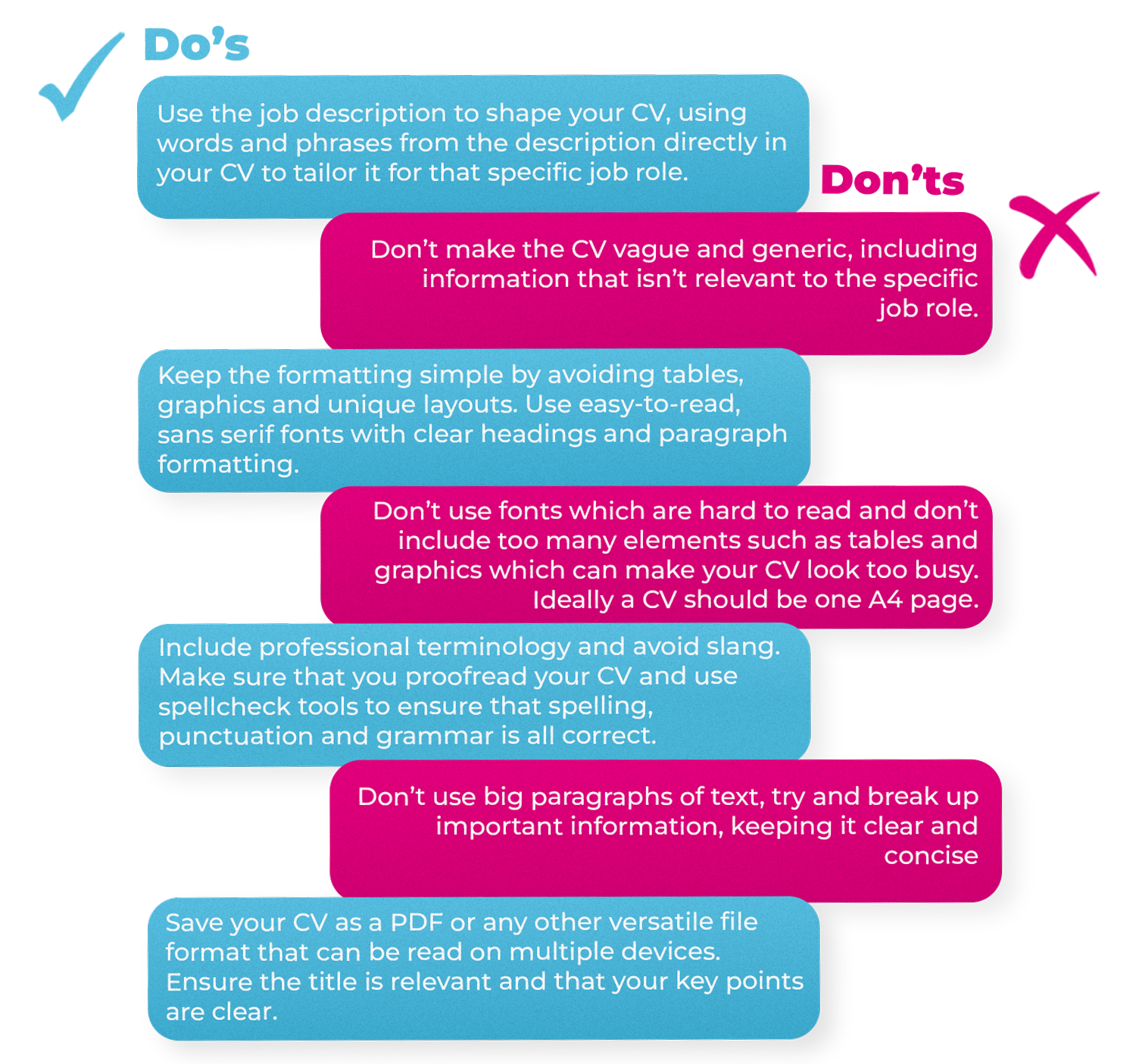
Quick top tips to enhance your CV and make it stand out to an employer.
- Showcase your interests and hobbies on your CV if they are relevant to the job. This can go alongside your experience and qualifications to show you are interested in the role and want to pursue a career in this industry. They also show the employer your personality and whether you would be the right fit for the role.
- If needed, change your email address to something more professional (e.g. your first name and last name) as this will make you look more serious to the employer. Your email address will be one of the first things the employer sees; it is important to make a good first impression.
- Use strong action verbs to show decisiveness (e.g. I ‘could’ be a good fit for the role is not as effective as I ‘would’ be a good fit for the role).
Using this guide you should be able to write the perfect CV, coming across as clear and decisive. Writing an effective CV can feel daunting, but hopefully, these tips can help you progress with your applications by creating a strong CV. We wish you the best of luck with your applications!
Are you applying for job roles or apprenticeships and need some extra support?
Contact the Optimum Skills team to find out about current apprenticeship and training opportunities to kickstart your career!